
By Hadis Hesabi, Co-founder and CTO of Xploreum
Sponsored contribution by Xploreum
A three-day camping trip can start to feel crowded before you leave home. You add a morning hike, a fishing outing, a sunset paddle, a scenic drive, and a few places to eat. Then you remember that someone still has to buy groceries, find the campsite, put up the tent, and make dinner.
For a relaxed three-day camping itinerary, stay at one campground for both nights, choose one main activity for the full day, and leave room for travel, meals, camp setup, and changing conditions. Keep arrival and departure days lighter. Optional stops should be easy to remove without upsetting the rest of the trip.
This guide focuses on a three-day, two-night trip to an established campground, with a Lake Ouachita example you can adapt to your dates and group. The schedule and time allowances are planning suggestions, not campground rules or confirmed reservations.
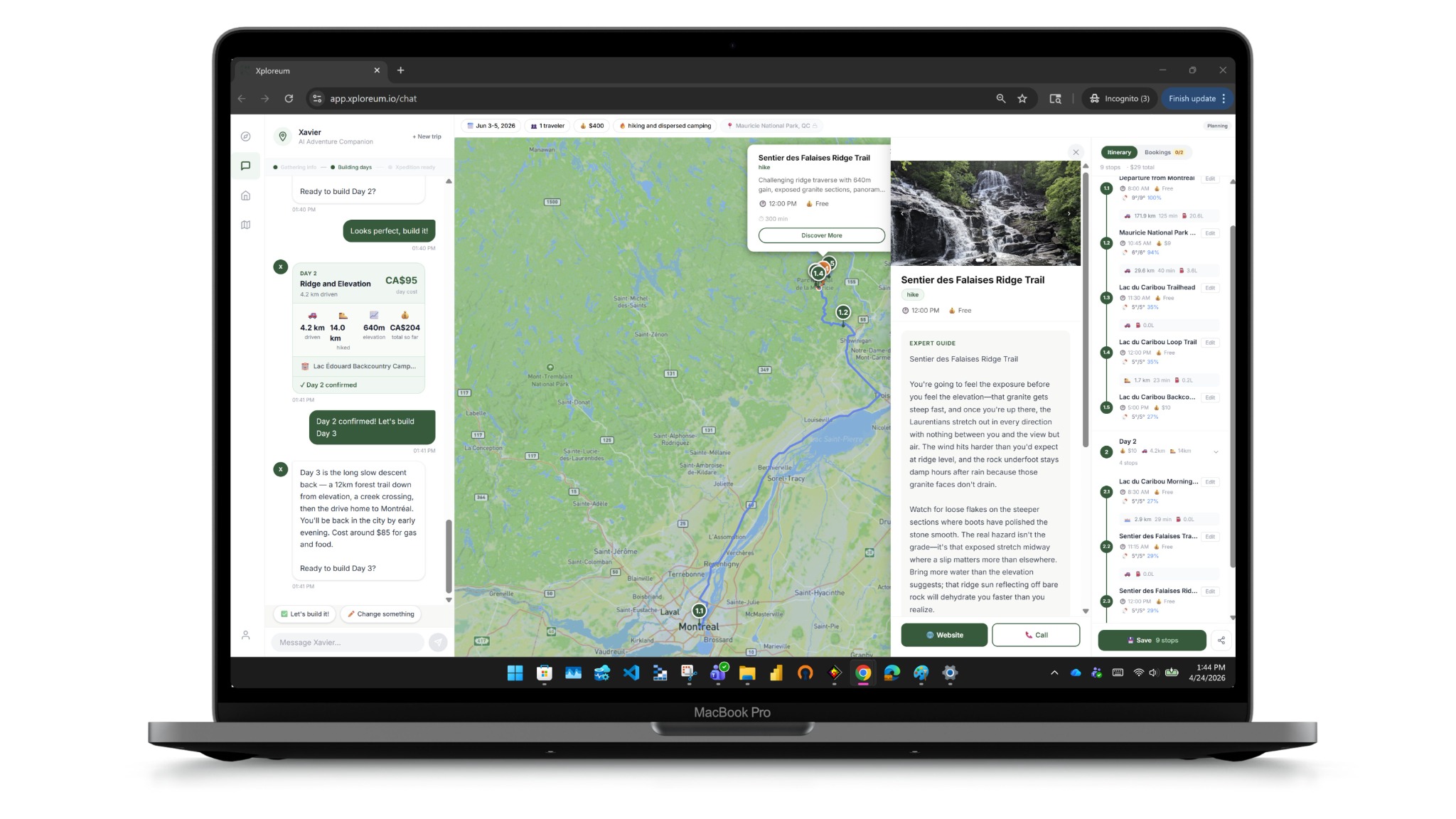
At Xploreum, this is the planning problem we work on: helping people connect the drive, outdoor activities, overnight stops, and everyday logistics. Xavier, our AI outdoor trip-planning companion, organizes those pieces into a day-by-day trip plan, called an Xpedition, that you review as it develops.
Start with the weekend you actually have
Before choosing trails or rentals, write down when you can leave home and when you need to be back. A Friday departure after work creates a different trip from a Friday morning departure, even when both are described as a three-day getaway.
Give the trip a short brief: your starting point, dates, group size, camping setup, preferred activity level, budget, and vehicle. Add the things that would make the weekend work for everyone, such as a nearby restroom, a slower walking pace, space for an RV, or time for children to play around camp.
Then account for the time that does not appear in a directions estimate. As an illustration, a three-hour drive plus 30 minutes for stops, a 30-minute delay allowance, one hour to set up, and one hour for dinner already uses six hours. The campground’s permitted arrival window may add another constraint. That is a substantial part of the first day before you have scheduled an outing.
For a first trip, give yourself more setup time than you think you need. Decide who brings the shared equipment and who handles food before departure. Packing the tent, stove, and first meal where you can reach them also makes the arrival sequence easier.
Choose and confirm your basecamp before filling the days
For a short camping weekend, keeping the same campsite for both nights avoids a second round of packing, driving, checking in, and setting up. Choose the basecamp around the activity you care about most. If fishing is the priority, examine access to your planned fishing location. If hiking is the priority, check the actual drive to the trailhead.
For local ideas, LakeOuachita.org’s Lake Ouachita trip-planning guide is a useful starting point. Confirm the details that affect your stay with the campground, land manager, or activity operator.
Lake Ouachita State Park offers several camping setups, including sites with hookups, sites without hookups, and walk-in tent sites. These choices affect what you bring and how you unload. Check the exact site description rather than assuming every tent site lets you park beside the tent.
The same care applies elsewhere around the lake. Recreation.gov lists electric campsites at Brady Mountain but explicitly states that the campsites do not have water hookups. An amenity label is a starting point; the detailed listing tells you what to plan for.
Before committing to the rest of the itinerary, confirm:
- The stay: availability for both nights, any minimum stay, the exact site, and the total charge.
- The arrival: check-in and check-out times, the late-arrival process, and any gate restrictions.
- The setup: tent or RV compatibility, parking distance, access, hookups, drinking water, and restrooms.
- The group: occupancy, vehicle, pet, and accessibility requirements.
- The conditions: current closures, fire restrictions, cancellation terms, and the services operating on your dates.
If a boat rental or guided outing is central to the weekend, check that arrangement early too. Confirm its meeting location, equipment, operating dates, return deadline, and weather policy. A campsite reservation does not reserve a boat.
For example, Lake Ouachita State Park currently lists its marina as closed from November through February. Confirm seasonal rental access before making a water outing the centerpiece of your trip.
For a fuller sequence, Xploreum’s camping and hiking booking checklist explains how to move from a trip idea to arrangements you have actually confirmed.
Build a three-day camping itinerary with room to enjoy it
For a two-night trip, the middle day usually gives you the largest uninterrupted block outdoors. Give it one main activity. Treat the first day as arrival and settling in, and the last day as breakfast, packing, and a comfortable journey home.
Before adding a second substantial activity, count its entire time commitment: getting there, parking, collecting equipment, the activity itself, returning equipment, and getting back to camp. A two-hour rental can occupy considerably more than two hours of the day’s schedule.
A sample Lake Ouachita camping weekend
This example assumes a reserved campsite at Lake Ouachita State Park and a group traveling by car. Clock times below are illustrative. Adjust them to your confirmed arrival and departure rules, daylight, activity duration, conditions, and everyone’s abilities.
| Day | Suggested schedule | Keep flexible |
|---|---|---|
| Day 1 Arrive and settle in | Arrive within the permitted window. Allow about 60 to 90 minutes for setup and finding facilities. Prepare a simple dinner with time to clean up before dark. | A short walk only if daylight, conditions, and energy allow. Remove it if the drive or setup runs late. |
| Day 2 Enjoy the main outing | 7:30 a.m. breakfast. Around 9 a.m., begin your chosen hike, fishing session, or arranged water activity. Allow a generous lunch break. Keep part of the afternoon open and return with time for dinner. | A nearby second activity is optional. Avoid arranging the day so a slower morning forces a rushed afternoon. |
| Day 3 Pack and head home | 7:30 a.m. breakfast. Begin packing around 8:30 a.m., or earlier if required. Inspect the site, remove your waste, and leave by the confirmed check-out time. | Add a brief stop only if it fits the return route and your arrival-home target. |
At the state park, Dogwood Trail is officially listed as an easy, half-mile walk. It may suit a short optional outing when the conditions and group are right.
Caddo Bend Trail is a different commitment: the park lists it as four miles and strenuous. For a prepared group, it could be the main activity of the day. Choose it based on everyone’s ability and the conditions, and allow your own margin for breaks.
If fishing is the reason for your Lake Ouachita camping trip, give fishing the main block and shorten the hiking plan. Check current Arkansas fishing-license requirements before you go. The Arkansas Game and Fish Commission generally requires anglers aged 16 and older to carry a valid license. Also check the rules for the water and species you intend to fish.
Budget time for meals and pack for the trip you chose
A realistic camping itinerary includes cooking and cleanup. Decide which meals you will eat at camp, which will happen during travel, and which need to come with you on an outing.
For a Friday afternoon to Sunday morning stay, you might need two campsite dinners, two breakfasts, and Saturday lunch, plus food for the journeys. Count from your actual departure and return times. Do not automatically buy three full days of elaborate campsite meals.
Make the first dinner easy to prepare, use ingredients across more than one meal, and have a simple backup that does not depend on catching fish or finding an open shop. Plan safe food storage for the conditions and your campground’s rules. If you plan to cook, confirm that your method is permitted; use camping stoves outdoors.
Match the equipment list to the activities that survived your planning decisions. An optional fishing session does not need to turn into a second vehicle full of gear, and a relaxed campground stay does not require equipment for every outdoor activity you might try someday. Keep the essentials that protect comfort and safety.
Use this core three-day camping checklist, then adapt it to your group and the forecast:
- Camp and sleep: suitable shelter, required poles and stakes, bedding for expected conditions, and a sleeping pad.
- Food and water: counted meals, drinking water and refill plan, suitable storage, cooking equipment if needed, and cleanup supplies.
- Clothing: layers, rain protection, appropriate footwear, and dry spare clothing.
- Light and power: a headlamp for each person, spare batteries or charging equipment, and a charged phone.
- Health and hygiene: personal medication, a first-aid kit, sun protection, insect protection, and toiletries.
- Trip details: reservation confirmations, any required licenses, operator contacts, and maps you can access without a connection.
- Activity equipment: the items needed for your actual plan, including properly fitted life jackets for water activities.
The Parks Victoria camping packing checklist provides another practical reference for checking your equipment. Confirm what your campground and any rental operator provide before buying or loading extra items.
Decide on your weather backup before departure
A weather backup works best when it includes a decision, a place, and a way to get there. Check the forecast for the actual campground and activity area, then recheck it close to departure and before going out.
For ordinary rain, a shorter suitable outing or a visit to an open indoor attraction may fit the day. Consider road access and the conditions at the destination as well as the weather at camp. For severe weather, the right decision may be to delay, shorten, or cancel the trip.
Lightning needs a specific plan. The National Weather Service explains that tents and open-sided picnic shelters do not provide safe lightning shelter. When you hear thunder, move immediately to an enclosed vehicle with a metal roof and closed windows, or a substantial building equipped with plumbing or electricity. Follow the NWS advice to remain sheltered for at least 30 minutes after the last thunder before resuming outdoor activity. Do not substitute a hike for a paddle when thunderstorms make outdoor activity unsafe.
Before leaving, agree on who checks conditions, where the group can shelter, and when you will abandon an outing. Keep cancellation information and operator contacts accessible. Leaving time open makes these changes easier to absorb.
Use an AI camping trip planner to organize your own weekend
The sample schedule gives you a structure. Your starting point, dates, group, and confirmed campsite turn it into your trip.
With Xploreum, you give Xavier that context, confirm the trip brief, and review the proposed days in sequence. An Xpedition connects the daily itinerary and mapped stops, helping you see how the journey fits together. As the laptop example above illustrates, you can review the conversation, itinerary, and details of a selected stop together before deciding what belongs in the day. You can ask for revisions during planning.
Use this prompt as a starting point, replacing the brackets with your details:
Help me plan a three-day, two-night camping trip around Lake Ouachita. We are starting from [city] on [date] and need to be home by [time] on [date]. There are [number] of us, traveling in [vehicle], with a budget of [amount and currency]. We prefer [tent or RV] camping and [easy or moderate] activity. Our campsite is [confirmed campground and site, or still to be chosen]. Keep the same basecamp for both nights. Make [fishing, hiking, or paddling] the main outing, and leave time for meals, setup, breaks, and the drive home. Include a weather alternative and identify the arrangements we need to verify ourselves.
When you review a day, make the changes concrete: “Remove the second hike,” “Allow more time for lunch,” or “Use our confirmed campground as the overnight stop.” Review each revised day before continuing.
When Xplorer Pro becomes useful
Start Day 1 without an account, then create a free account to continue and save your Xpedition. Xplorer Pro is required to open the full saved itinerary and map.
Pro also lets you revise the saved plan with Xavier, share a read-only link with your group, and keep reservation details you enter yourself in a booking log. That makes it useful when you want to return to the plan, coordinate the weekend with others, and keep confirmed arrangements beside your itinerary.
Make reservations directly with the campground or operator and verify availability, access, and conditions with the appropriate sources. Xavier does not make bookings or confirm live availability, and Xploreum does not provide its own offline maps or turn-by-turn navigation.
Common questions about planning a three-day camping trip
How many activities should I plan each day?
For a relaxed two-night weekend, start with one substantial outing on the full day. Keep arrival and departure days lighter. Add a short extra only after allowing for travel, meals, equipment, breaks, and the group’s energy.
Should I stay at one campground or move each night?
For this kind of short basecamp trip, one campground is a practical starting choice. Moving makes sense when the route or the purpose of the trip requires it. Otherwise, consider whether the benefit of a second location is worth another packing and setup cycle.
What should I book first for a camping weekend?
Confirm your campsite and any required entry or access arrangements. Check an essential rental or fixed-time outing early as well. Then fit the remaining activities and meals around those commitments.
Can I combine camping, hiking, and fishing in one weekend?
Yes, if the locations, conditions, and time commitments fit. Decide which activity matters most and give it the main block. A short walk and a longer fishing session can make more sense than trying to complete every activity at its maximum length.
How can AI help me plan a camping trip?
AI can help turn your constraints and preferences into an organized draft. Give it the details that matter, review the result, and correct assumptions. Confirm reservations and current outdoor conditions directly before treating the plan as ready to use.
Turn the idea into your next camping trip
Choose the dates, decide what you most want from the weekend, and give the rest of the schedule room to breathe. A campsite you can settle into, an outing you have time to enjoy, and a manageable drive home are a strong foundation.
Start planning at xploreum.chat. Tell Xavier what you have in mind and build the first day. Create a free account to continue your Xpedition, then explore Pro when you want to open and manage the saved plan.